


 English
  中文简体
中文简体
Content
The Direct Impact of CVD on Carbon Felt Electrodes
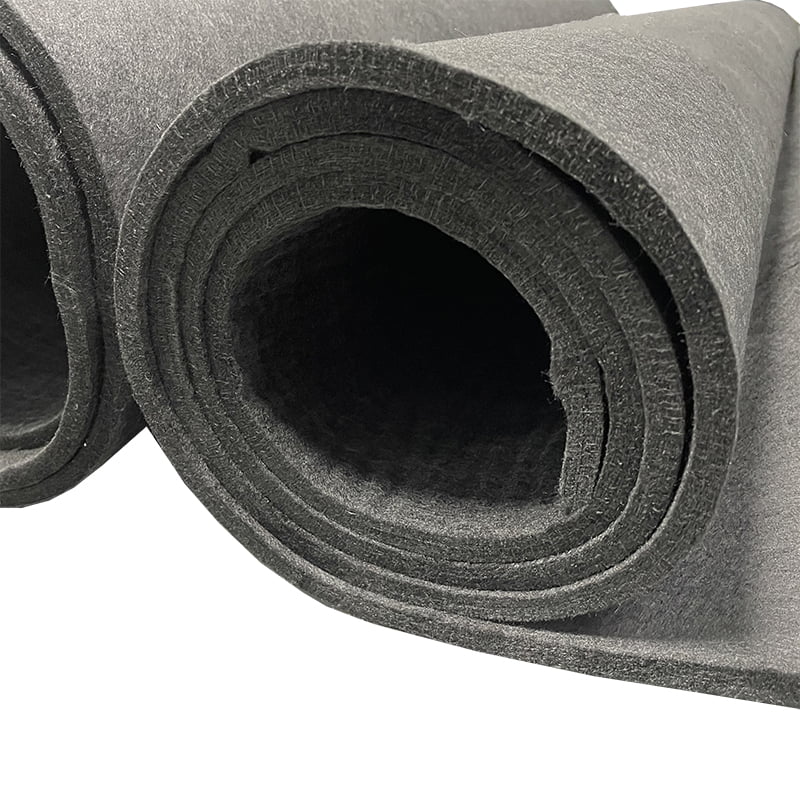
Chemical vapour deposition (CVD) modification improves carbon felt electrodes by depositing a thin, conductive layer of carbon or catalytic nanostructures directly onto the fibre surfaces. This process increases the specific surface area by up to 100 times compared to untreated felt, dramatically reducing charge transfer resistance and boosting the reaction kinetics needed for high-efficiency flow batteries. The enhanced electrode does not just survive the acidic electrolyte — it performs consistently across thousands of charge-discharge cycles, maintaining a voltage efficiency above 80%. This makes CVD carbon felt electrode for flow battery applications the current benchmark for combining durability with electrocatalytic activity.
The modification directly addresses the fundamental limitation of pristine carbon felt: its intrinsically low surface area and poor wettability by the electrolyte. Without treatment, the felt fibres are smooth and hydrophobic, providing minimal active sites for the vanadium ion redox reactions. CVD treatment grows a porous, nanocrystalline carbon layer or a forest of carbon nanotubes (CNTs) that multiply the reaction interface and transform the surface from water-repellent to highly hydrophilic, allowing the electrolyte to fully permeate the electrode.
Carbon Felt Electrodes in Flow Batteries: The Critical Role
A carbon felt electrode for flow battery systems serves as the porous scaffold where the liquid electrolyte's charge-storing ions undergo oxidation and reduction. The electrode does not store energy itself; it provides the conductive surface where the vanadium species exchange electrons. How are carbon felt electrodes used in flow batteries is best understood as a three-dimensional reaction platform. The electrolyte is pumped through the felt, and the entire internal surface area is available for electrochemical reactions, making the electrode's microstructure the single largest determinant of power density.
What makes a good electrode material for flow batteries is a combination of high electrical conductivity, excellent chemical stability in strongly acidic electrolytes, and a large, wettable surface area with catalytic activity toward the desired reactions. Carbon felt meets the stability and conductivity requirements baseline, but its surface area and reactivity must be engineered. How does electrode surface area affect battery performance directly: the reaction current is proportional to the available active area. A doubling of electrochemically active surface area can increase the limiting current density by 40–60%, enabling a more compact and cost-effective battery stack.
CVD Modification: How the Process Works and What It Achieves
How does CVD modification improve carbon felt electrodes starts with a thermal process. Carbon felt is heated to 600–900 °C in a furnace under flowing inert gas, then a carbon-containing precursor such as methane, ethylene, or acetylene is introduced. The precursor decomposes on the hot fibre surfaces, depositing a thin, highly graphitic carbon layer that conformally coats every fibre. This layer is not a flat skin but a complex of nanoscale flakes, ridges, and pores that drastically increase the surface roughness and the density of edge-plane sites, which are known to be catalytically active for vanadium redox reactions.
The result is an electrode with a specific surface area that can exceed 5 m²/g compared to the 0.1–0.3 m²/g of the pristine felt. This expanded area is fully active because the deposited carbon layer is also inherently hydrophilic, allowing the aqueous electrolyte to wet the entire surface. Electrochemical testing routinely shows a reduction in charge transfer resistance from over 10 ohm·cm² to under 1 ohm·cm² after CVD treatment. In a flow battery, this translates to a higher voltage efficiency at a given current density. A CVD-modified felt can operate at 100 mA/cm² with a voltage efficiency of 82–85%, whereas an untreated felt at the same current may drop to 72–75% due to high activation and ohmic losses.
CNT-Modified Carbon Felt: A Subset of CVD Enhancement
How does CNT modification improve carbon felt electrodes builds on the same CVD principle. When the precursor gas is switched to a carbon source mixed with a catalyst such as ferrocene, carbon nanotubes (CNTs) grow directly from the fibre surface rather than forming a flat coating. The resulting felt has a dense, entangled network of multi-walled CNTs that can increase the specific surface area to 10–20 m²/g. This creates a hierarchical pore structure where the large gaps between fibres allow electrolyte flow, and the nanometer-scale spaces between CNTs vastly increase the reaction interface.
The CNT forest also provides a unique advantage: the nanotubes themselves are highly conductive and act as charge collectors that extend the electrode's electronic reach deep into the electrolyte. This reduces the ionic diffusion path length and improves the utilisation of the active species. A CVD carbon felt electrode for flow battery with an optimised CNT layer can achieve a peak power density improvement of 25–35% compared to standard CVD treatment. However, the CNT synthesis step requires tighter control of the catalyst distribution and growth time to avoid blocking the felt's macro-porosity and impeding electrolyte flow.
How to Improve Carbon Felt Electrode Performance Beyond CVD
How to improve carbon felt electrode performance combines CVD treatment with complementary steps. Thermal pre-treatment in air at 400–500 °C before CVD can pre-activate the fibre surface by creating micropores and oxygen functional groups that serve as nucleation sites for the carbon deposit. Post-CVD doping with nitrogen or boron using a nitrogen-containing gas during deposition creates catalytically active heteroatom sites. The table below summarises the performance gains achievable with different modification strategies.
| Electrode Type | Specific Surface Area (m²/g) | Voltage Efficiency at 100 mA/cm² | Peak Power Density (mW/cm²) |
|---|---|---|---|
| Untreated carbon felt | 0.1–0.3 | 72–76% | 250–300 |
| CVD carbon-coated felt | 2–5 | 82–85% | 350–420 |
| CNT-modified felt (CVD) | 8–20 | 84–88% | 420–550 |
A comprehensive approach to how to improve carbon felt electrode performance also includes post-treatment acid washing to remove residual metal catalysts and ensure long-term chemical stability. The goal is an electrode that not only performs well on the first cycle but maintains its efficiency over 10,000+ cycles, which is the commercial viability threshold for grid-scale flow battery storage. CVD-modified carbon felt, especially when enhanced with nitrogen doping or a CNT layer, currently sets the standard for meeting this requirement.